Bioluminescence, various chemical reactions causing animals to produce light, let’s talk about it!
Firstly, let’s explain how this chemical reaction occurs. The key player is a substance called luciferin. Luciferin reacts with oxygen to produce light energy; this only works, however in the presence of luciferase, which “oversees” or catalyzes the reaction.
This is super common, in fact, 80% of deep sea creatures are thought to be bioluminescent. It is also thought that it developed 27 different times (more on that in a bit). 1 As for why, the reasons are quite diverse, ranging from mating to catching prey.
One reason for bioluminescence in some animals, like dinoflagellates, is that they emit light when they sense a predator nearby. This behavior may seem counterintuitive, but it has an intriguing purpose: it can potentially make the predator itself more vulnerable by drawing the attention of larger predators higher up the food chain. For instance, consider the scenario of grazing copepods encountering bioluminescent phytoplankton cells. Instead of consuming these glowing cells, they release them unharmed. Why? If the copepods were to eat them, they would themselves start to emit light, essentially sending out a beacon that could attract even bigger predators.
To address the issue of glowing stomach contents in predatory deep-sea fishes, nature has a clever solution. These predators have evolved stomachs with a black lining that can block the light emitted by any bioluminescent fish they may have swallowed. This ingenious adaptation prevents the glow from within their stomachs from attracting attention and keeps them hidden from larger predators2.
Over 700 genera contain light-producing species, with most marine bioluminescence falling within the blue and green light spectrum. Some exceptions include certain fish emitting red and infrared light, along with the genus Tomopteris emitting yellow light. Here is a tree showing the distribution of bioluminescence.

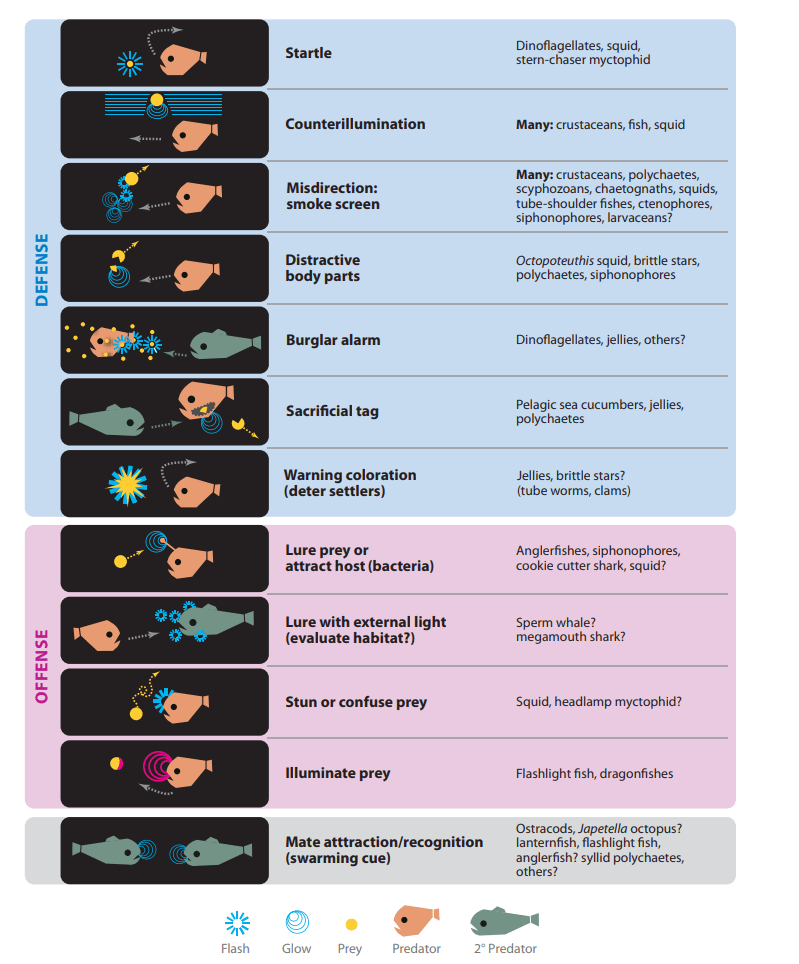
In general, bioluminescence serves so many functions. In addition to the function I talked about earlier, bioluminescence can distract or misdirect a predator for a time, allowing the prey to quickly escape; acting as a literal smoke screen. A glowing light can also signal to predators that the potential prey is toxic, or even serve as a warning sign for others that a predator is in the area.
Here is a full diagram of all the functions
- Davis, Matthew P et al. “Repeated and Widespread Evolution of Bioluminescence in Marine Fishes.” PloS one vol. 11,6 e0155154. 8 Jun. 2016, doi:10.1371/journal.pone.0155154
↩︎ - Haddock, S. H. D., Moline, M. A., & Case, J. F. (2010). Bioluminescence in the Sea. Annual Reviews. https://doi.org/10.1146/annurev-marine-120308-081028
↩︎
 Micah Zarin's Blog
Leave a comment