Math has a notorious reputation for being a dry, difficult, and even painful subject for many. The meticulous proofs, endless drill problems, and strict rules can feel confining compared to more creative pursuits. But what if we’ve been learning math all wrong? I will show you how you can make math enjoyable and become better at it.
Art of Problem Solving (AoPS)
The AoPS books are a really good resource for finding problems to work on (practice is really the only way to improve). Here is a link to them. They contain interesting problems that make math feel like a puzzle instead of memorization. Something about puzzles is that they are hard. You will 100% not be able to solve every single problem, and thats okay! The way these books work is that they will give you the tools you need to solve a problem, but you have to figure out how to use these tools to solve a problem. Here is an example of some problems from the intermediate algebra book.
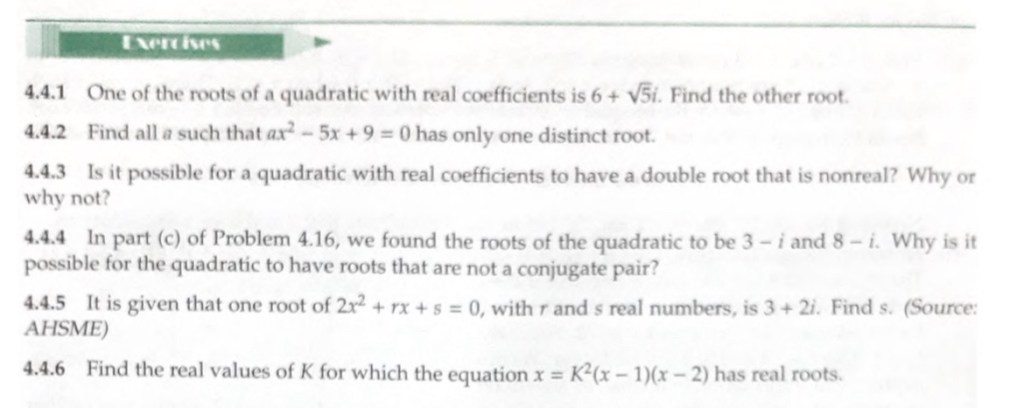
They will show you various tools and why they work, such as finding the sum of the roots of a quadratic or the product of the roots. The explanations are also really good.
Backburner Problems – Be Bored
Boredom gets a bad rap. We often view it as a waste of time or a state to avoid. But there are upsides to feeling bored that many overlook. When the mind is bored and craving stimulation, it sparks creativity and reflection.
Specifically, boredom can enhance how deeply we think through complex problems. When faced with a challenging math equation or physics concept, our initial impulse is to intensely focus, grinding through each logical step until we reach a solution. Without focused distractions, the bored brain naturally meanders into creative exploration of new approaches to the problem. Moments of boredom allow promising ideas that don’t fit into linear logic to percolate.
Start by picking an math problem beyond your current competency – preferably from the AoPS books mentioned above. Then, become bored. Lean into the feeling and let your mind roam. The fresh perspectives generated during periods of boredom can bring the creative insights you need to untangle complex challenges. Think of boredom as the springboard for out-of-the-box thinking.
Change the Problem
Here is an example of a very challenging problem that 3B1B made a video on

This problem may be seem complicated, but try it in 2D.

Essentially, if we place a third point on this circle, what is the probability that when we connect all three points on the circle to form a triangle, that triangle will contain the center of the circle. Take a moment to understand what this is asking. Here is the solution
Play Like a Kid
In math, we’re frequently taught to methodically work through problems step-by-step to reach the single expected solution. But this conditions us to stop thinking once the first answer is obtained, hindering further exploration.
Next time you reach an answer, force yourself to keep thinking creatively beyond that point. Ask yourself questions like: Can I solve this in a different way? What if I modify the constraints? Is there a way to generalize this problem and reach other solutions? What alternate representations could provide new insight?
Resist the urge for quick completeness. Explore the problem from different angles to extract key ideas and relationships previously unseen. Think of math solutions less as endpoints and more as launch points to investigate broader concepts. You’ll be amazed at the novel directions creative persistence can unveil. After all, math is somewhat man-made.
Make Mistakes on Purpose
Make mistakes…on purpose! Intentionally apply incorrect concepts or flawed logic at points. See what you can learn from the resulting mess as you unravel where your reasoning went wrong. Think of mistakes as rich learning experiences, not failures. Insights bubble up when we step outside the bounds of convention. You will end up learning a lot!
Closing Words
In closing, math education often overemphasizes logical rules and underappreciates creative intuition. But as you’ve now learned, with the right training and mindset adjustments you can absolutely ignite your innate math creativity. Be patient and persistent. Allow yourself to think flexibly outside the bounds you once assumed were rigid. A new world of mathematical possibility awaits those bold enough to unleash their creative spirit
 Micah Zarin's Blog
Leave a comment