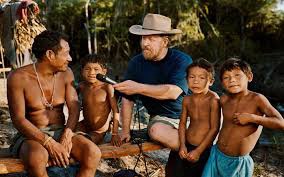
In the dense Amazon rainforest of Brazil, along the winding Maici River, resides the Piraha tribe, a small indigenous community of about 300 people. Their language, also called Piraha, has baffled and intrigued linguists for decades due to its unique features that seem to defy many long-held assumptions about the nature of human language.
One of the most striking aspects of the Piraha language is its lack of numerals. While most languages have words for specific numbers, Piraha has no terms for even the most basic quantities like “one”, “two”, or “three”. Instead, they use relative terms to describe amounts. “Hói” indicates a small quantity, while “hoí” refers to a larger amount. The exact number is less important to the Piraha than the general concept of “few” or “many”.
This lack of numerical terms extends to other areas of the language as well. The Piraha don’t have fixed words for specific colors. Instead, they describe colors in relation to objects from their environment. “Biísai” means “like blood”, while “kopaíai” means “like a leaf”. These terms are always tied to specific referents rather than being abstract color labels.
Similarly, the Piraha language lacks fixed terms for directions like “left” and “right”. They use relative spatial terms that are dependent on the speaker’s perspective or the flow of the river. “Ibigaí” means “upriver”, while “igobí” means “downriver”. This reflects the Piraha’s strong connection to their immediate environment and their lack of need for abstract directional concepts.
Perhaps the most controversial claim about the Piraha language is that it lacks recursive structures. Recursion, the ability to embed clauses within clauses to create complex sentences, is considered by many linguists to be a universal feature of human language. However, some researchers, most notably linguist Daniel Everett, have argued that Piraha shows no evidence of recursion.
For example, instead of saying “The man who was wearing the red hat walked into the forest”, a Piraha speaker would say something like “The man walked into the forest. He was wearing a hat. The hat was red.” Each idea is expressed in a separate, simple sentence without embedding.
This claim has sparked intense debate within the linguistic community. Some see it as evidence that recursion may not be a necessary component of human language, challenging influential theories like Noam Chomsky’s Universal Grammar. Others argue that the apparent lack of recursion in Piraha could be due to cultural factors rather than a true linguistic limitation.
The Piraha language is deeply entwined with the tribe’s culture and way of life. The Piraha have a strong emphasis on direct experience and a lack of interest in abstract concepts or anything beyond their immediate perception. This is mirrored in their language, which is highly concrete and specific.
The Piraha have no creation myths, no fiction, and no art. Their stories are limited to events directly experienced by someone in the tribe. They have no social hierarchies, no rituals, and no concept of a distant past or future. Their language reflects this focus on the present and the tangible.
Some researchers suggest that the unique features of Piraha are a result of these cultural factors. The lack of numbers, colors, and recursion may stem from the Piraha’s lack of need for these concepts in their daily lives. Their culture shapes their language.
Others propose that the influence could go the other way – that the Piraha’s language shapes their culture and cognition. If certain concepts can’t be expressed linguistically, it may be more difficult to think about them or incorporate them into one’s worldview.
Regardless of the direction of influence, the Piraha language provides a fascinating case study of the complex interplay between language, culture, and thought. It challenges our assumptions about what is universal in human language and cognition.
The Piraha have no need for a written language. Their rich oral tradition, passed down through generations, preserves their stories, knowledge, and way of life. The spoken word, in all its immediacy and concreteness, is the lifeblood of Piraha culture.
As we continue to study languages like Piraha, we’re forced to confront our preconceptions about the limits and possibilities of human language. We’re reminded of the incredible diversity of linguistic structures and the ways in which language is shaped by and shapes the lives of its speakers.
 Micah Zarin's Blog
Leave a comment