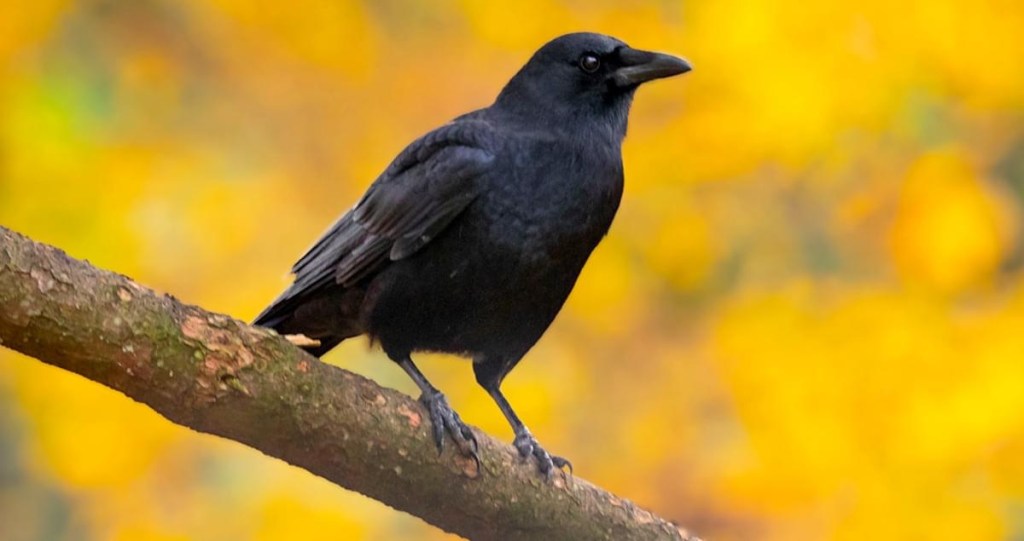
I have never been able to look at a crow without feeling as though I were being studied in return. Their gaze is not the soft, glassy gaze of other birds. It is hard and exacting, like the tip of a needle. It lingers. Most animals look at you and see only your shape, the space you occupy in the world. A crow looks at you and sees something deeper. It remembers you.
The Memory Game
In Seattle, researchers wore masks while capturing wild crows for tagging. The crows screamed and mobbed the masked figures, a fury you might expect for any predator. But the experiment wasn’t about the capture itself—it was about what happened after.
Years later, the researchers returned to the same area wearing the same masks. The crows remembered. They screamed again, warning their kin, swooping low in aggressive arcs. But here’s the part that stays with me: it wasn’t just the original crows who reacted. The knowledge had spread. Their offspring, other crows who weren’t even alive during the initial study, joined in the mobbing. The information had passed from one generation to the next, a story told and retold until it became part of their collective memory.
What does a crow do with memory like that? What does it mean for an animal to hold a grudge, not just individually but as a group, as a species? They are not just reacting to danger; they are cataloging it. Somewhere in the strange circuitry of their brains, there is a ledger, a list of faces and deeds, a record of who can be trusted and who cannot.
The Crow’s Hands Are Its Mind
Years ago, I saw a crow on the side of the road, holding a stick in its beak, jabbing it into a muddy patch of grass. It pulled the stick out, shook it, and jabbed it again. I didn’t understand what I was seeing then, didn’t realize that I was watching a kind of small miracle.
Crows use tools. Not just casually, not just occasionally, but with the kind of deliberate purpose that suggests invention. In New Caledonia, crows have been observed crafting tools out of twigs and leaves, stripping them down, bending their edges to create hooks for extracting insects from tree bark. And when there are no twigs, no leaves, they improvise. In one experiment, a crow was given a straight piece of wire and a food reward trapped in a tube. The crow bent the wire into a hook and retrieved the food.
I cannot make sense of this. I try to imagine a crow looking at a piece of wire, seeing not what it is but what it could become. It is a kind of thinking that feels too close to our own.
But it doesn’t stop there. Crows can solve puzzles that require multiple steps, using one tool to retrieve another, which is then used to complete the task. This is not trial and error. This is planning. Foresight. And it isn’t just instinct, because young crows don’t figure out these tools on their own. They are taught.
What do we call this? Innovation? Engineering? It feels strange to use these words for a bird, but no other words seem to fit. A crow does not have hands. It does not have the luxury of opposable thumbs. What it has is its mind.
Death: What the Crows Know
When a crow dies, the others gather. I have seen this myself, though I didn’t know what I was seeing at the time. A dead crow in the road, its body still and crumpled, its feathers flat against the pavement. Five or six other crows stood nearby, not eating, not moving. Just watching.
Scientists call this behavior a “crow funeral,” though the name feels almost too human, too sentimental. The crows do not mourn the way we do. They do not cry or bury their dead. What they do is learn. They study the body, the circumstances of its death, searching for clues, for answers. Was it a predator? A trap? A human?
Once they have learned what they can, they leave. But not before sharing what they know. The knowledge spreads, a warning passed through the group like a ripple in water.
What must it feel like to be a crow, to live in a world where death is not just a moment but a lesson? To see the body of one of your own and not just feel loss, but understanding?
Watching
The crows are outside again. I sit by the window and watch them, and they watch me. I wonder if they know me, if they remember my face, my movements, my habits. I wonder if they have judged me and found me lacking.
There is something about them that feels ancient, as though they are not just birds but messengers, sent here to remind us of something we have forgotten. They are not beautiful in the traditional sense, but there is beauty in their sharpness, in their precision, in the way they move through the world with such quiet assurance.
The world belongs to them as much as it belongs to us. Maybe more. They do not need us, not really, but they have learned to live with us, to thrive in the spaces we leave behind. They are not waiting for us to notice them. They are watching. And they remember.
 Micah Zarin's Blog
Leave a comment