What is Boredom?
To talk about the importance of boredom, I think it is important to define boredom itself. Psychologists argue about this definition a lot, but many define boredom as an experience of wanting to engage in a satisfying activity but being unable to1. This state often leads to a search for something that can hold our attention, pushing us towards new experiences.
Technically, boredom arises from a situation where the mental demand is low, and there’s an absence of engagement. It’s not merely the absence of doing something but the desire to be stimulated without knowing how to achieve it2. Boredom is what drive us to seek new challenges, ideas, or hobbies.
Isaac Newton
During the Great Plague of London in 1665, Cambridge University was forced to close, leading Sir Isaac Newton to spend time at his family’s home in Woolsthorpe. Away from his academic commitments, Newton experienced a period of what many would describe as boredom. It was in this state of apparent idleness that he began to formulate the ideas that would eventually lead to the development of calculus.
Creativity
When the mind is not focused on a specific task, it’s free to explore, imagine, and create. This unfocused state allows for the kind of creative thinking that leads to artistic expression, problem-solving, and innovation. Research supports this, showing that people often come up with their most creative ideas when they are bored3, not when they are busy or distracted. This is because boredom encourages divergent thinking, a type of thinking that explores many possible solutions and is often linked to creativity.
In addition to fostering creativity, boredom can also enhance our ability to approach problems in novel ways. Without the usual constraints of focused work, our minds can make unique connections that would not occur under different circumstances. This can lead to innovative solutions to complex problems, as well as creative works that push the boundaries of what is possible. By embracing boredom, we can unlock our creative potential and open ourselves up to new ways of thinking and seeing the world.
Neurological Perspective
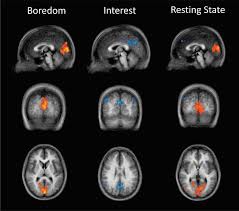
On the neurological level, the relationship between boredom and creativity involves intricate brain networks and processes. Specifically, the activation of the Default Mode Network (DMN) plays a central role in this phenomenon4. The DMN is a collection of interconnected brain regions that become more active when we are not focused on the external environment but are engaged in introspective activities such as daydreaming, reminiscing, or envisioning the future. This network includes areas such as the medial prefrontal cortex, posterior cingulate cortex, and the angular gyrus, among others.
The significance of the DMN’s activation during periods of boredom lies in its association with self-generated thought and the capacity for internal reflection and imagination. When external tasks do not demand our attention, the DMN facilitates a state of mind-wandering, which is conducive to creative thinking. This mind-wandering state allows for the exploration of ideas and the formation of novel connections between seemingly unrelated concepts5. It is in this neurologically facilitated environment that creativity can flourish, as the brain is free to explore and synthesize new information without the constraints of focused attention on specific tasks.
Additionally, the interaction between the DMN and the brain’s executive network6, responsible for goal-directed thought and action, is critical in the creative process. While the DMN supports idea generation and associative thinking, the executive network helps in the evaluation and refinement of these ideas. Both of these help the emergence of creativity that is both novel and applicable within a given context.
Introspection
The quiet moments of boredom provide an invaluable opportunity for self-reflection. In the absence of external distractions, we are more likely to turn inward and engage with our thoughts and feelings. This introspection can lead to a deeper understanding of ourselves, our desires, and our motivations. It allows us to consider our lives more thoughtfully, making it possible to identify areas where we seek change or improvement.
Self-reflection during periods of boredom can also lead to increased self-awareness, which is important for emotional intelligence and personal growth. By understanding our own emotions, strengths, and weaknesses, we can make more informed decisions, improve our relationships, and navigate life’s challenges more effectively. The introspective insight gained from boredom can be a powerful tool for personal development, helping us to lead more fulfilling lives.
- https://pubmed.ncbi.nlm.nih.gov/26168505/#:~:text=Through%20the%20synthesis%20of%20psychodynamic,conceptualization%20onto%20underlying%20mental%20processes. ↩︎
- https://journals.sagepub.com/doi/10.1177/1745691612456044 ↩︎
- https://www.sciencedirect.com/science/article/abs/pii/S0022103113002205 ↩︎
- https://pubmed.ncbi.nlm.nih.gov/26979438/ ↩︎
- https://www.nature.com/articles/s41380-021-01403-8 ↩︎
- https://www.ncbi.nlm.nih.gov/pmc/articles/PMC4017816/ ↩︎

 Micah Zarin's Blog
Leave a comment